If you’ve ever woken up in January with a scratchy throat and watched static electricity arc every time you touched a doorknob, you already understand what low humidity does to a house. Humidity — specifically relative humidity (RH), the percentage of moisture the air holds relative to its maximum capacity at a given temperature — drops fast in winter when cold outdoor air is pulled inside and heated. The EPA’s Indoor Air Quality guidance recommends keeping indoor RH between 30% and 50% for comfort and health. The question most homeowners eventually land on: should I buy another portable humidifier, or is it time to look at a whole-house system? This article answers that question by doing the one thing most buying guides skip — comparing actual output capacity in gallons per day (GPD), the number that determines whether a humidifier can actually keep up with your home’s demand.
By the time you finish reading, you’ll have a clear decision framework: what portables realistically cover, where whole-house systems start to make economic and practical sense, and how to avoid the most expensive mistake in this category — buying the wrong tier for your square footage.
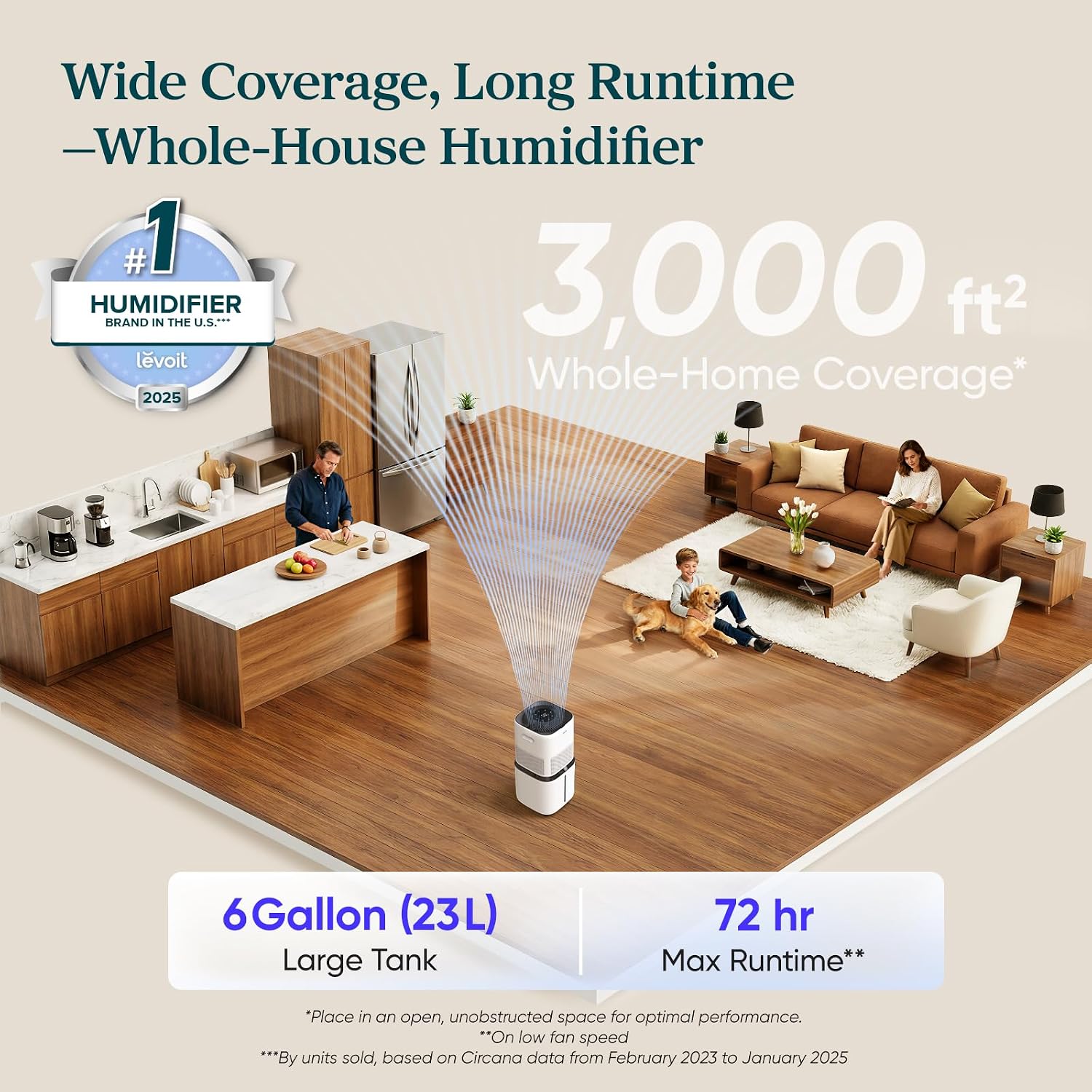
| EDITOR'S PICK[LEVOIT Superior 6000S Smart Eva…](https://www.amazon.com/dp/B0G1SQ5C11?tag=greenflower20-20) | Mid-tier[LACIDOLL Humidifier Large Room](https://www.amazon.com/dp/B0DN62TVV6?tag=greenflower20-20) | Budget pick[Lacidoll Humidifier Large Room](https://www.amazon.com/dp/B0DN62TVV6?tag=greenflower20-20) | |
|---|---|---|---|
| Capacity | 6 Gal | 6.8 Gal | 5.3 Gal |
| Coverage | 3000 ft² | 3000 ft² | 2500 ft² |
| Output | — | 1800 ml/h | — |
| Type | Evaporative | Cool Mist | Cool Mist |
| Filter | ✓ | — | — |
| Price | $224.99 | $199.99 | $159.99 |
| See on Amazon → | See on Amazon → | See on Amazon → |
What “Gallons Per Day” Actually Means in Practice
GPD is the humidifier industry’s measuring stick. One gallon of water, evaporated into your home’s air, raises humidity meaningfully — but how meaningfully depends on your home’s volume, construction tightness, and the outdoor temperature differential.
Building Science Corporation’s digest BSD-013: Relative Humidity lays out the physics clearly: a loosely constructed older home loses moisture to the outside far faster than a well-sealed modern build. That means two homes with identical square footage can have wildly different GPD requirements to maintain 35% RH on a 10°F day.
Here’s a rough capacity ladder based on published manufacturer specifications and ASHRAE Standard 55-2023’s guidance on moisture loads:
| System Type | Typical GPD Output | Realistic Coverage |
|---|---|---|
| Single-room ultrasonic portable | 0.5 – 1.5 GPD | 150–400 sq ft |
| Large-room console portable | 2 – 4 GPD | 500–1,000 sq ft |
| Bypass drum (e.g., Aprilaire 400) | 12–17 GPD | Up to ~3,000 sq ft |
| Fan-powered bypass (e.g., Aprilaire 600) | 17–23 GPD | Up to ~4,000 sq ft |
| Steam (e.g., Aprilaire 800) | 11.5–34.6 GPD (model-dependent) | Whole house, tight or loose build |
That table tells a story most box-store marketing glosses over: the biggest console portable you can buy produces about 4 GPD. The entry-level whole-house bypass unit starts at 12 GPD. There is a 3x gap before you have even reached mid-tier whole-house territory.
The Real Math on Portable Stacking
This is where homeowners on the fence usually do the calculation and get uncomfortable. If your 2,400-square-foot home needs approximately 10 GPD to maintain 35% RH during a cold snap — a reasonable estimate per Building Science Corporation’s BSD-013 moisture load models for a moderately tight home in Climate Zone 5 — you would need three to five large-room consoles running simultaneously to approach that output.
That math has real consequences across cost, maintenance, and air quality.
Budget Tier: One or Two Portables for Spot Coverage
For a single room or a studio apartment, one quality evaporative console pulling 3–4 GPD is a workable, low-commitment solution. Evaporative portables at this tier typically draw 50–100 watts and cost $80–$120 per unit. Maintenance is a weekly tank refill and a roughly annual wick or filter replacement.
The EPA’s Indoor Air Quality materials document one important caveat at this tier: ultrasonic portables emit fine white mineral particulate when used with hard tap water — the minerals that don’t evaporate become airborne. In hard-water markets covering much of the Midwest and Southwest, evaporative is the better choice even at the portable tier because minerals stay trapped in the wick rather than dispersing into room air.
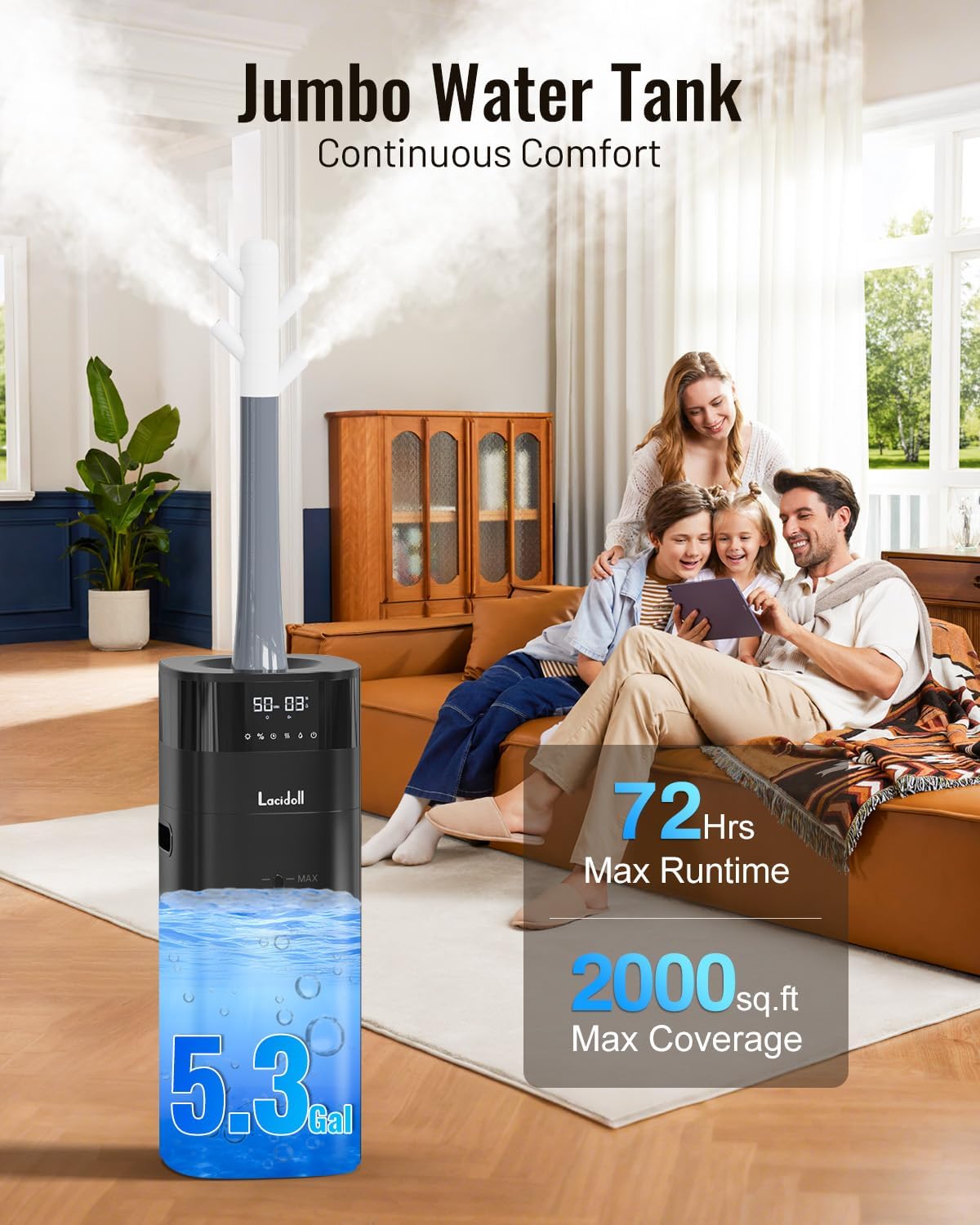
Lacidoll
$159.99
In stock on Amazon
Check price on AmazonMid-Tier: The Bypass Whole-House Unit for 1,200–2,500 sq ft Homes
Running four portables to cover a mid-size home creates costs most buyers underestimate. At the national average residential electricity rate (approximately $0.17/kWh as of early 2026, per U.S. Energy Information Administration published data), four 75-watt portables running 16 hours per day adds roughly $25–$35 per month to the electric bill. A fan-assisted or bypass whole-house unit adds closer to $3–$8 per month. This Old House’s Whole-House Humidifier Buying Guide notes that maintenance fatigue — emptying, refilling, and replacing media across multiple units — is the most commonly cited reason homeowners eventually switch to whole-house systems.
A bypass drum unit such as the Aprilaire 400 or Honeywell HE360 addresses both problems. Equipment pricing runs $150–$230 at authorized HVAC supply houses. ACHR News contractor cost coverage puts typical installed quotes in mid-market metros at $350–$600 all-in for a bypass drum unit. Self-installation is feasible for a willing DIYer: the connections are a saddle-valve water supply, two sheet-metal duct penetrations, and low-voltage wiring to the furnace control board.
One warranty note worth flagging: Aprilaire’s authorized dealer policy is explicit that third-party marketplace purchases can void manufacturer coverage. Buying from an authorized HVAC distributor rather than a third-party reseller is worth the marginal price difference.
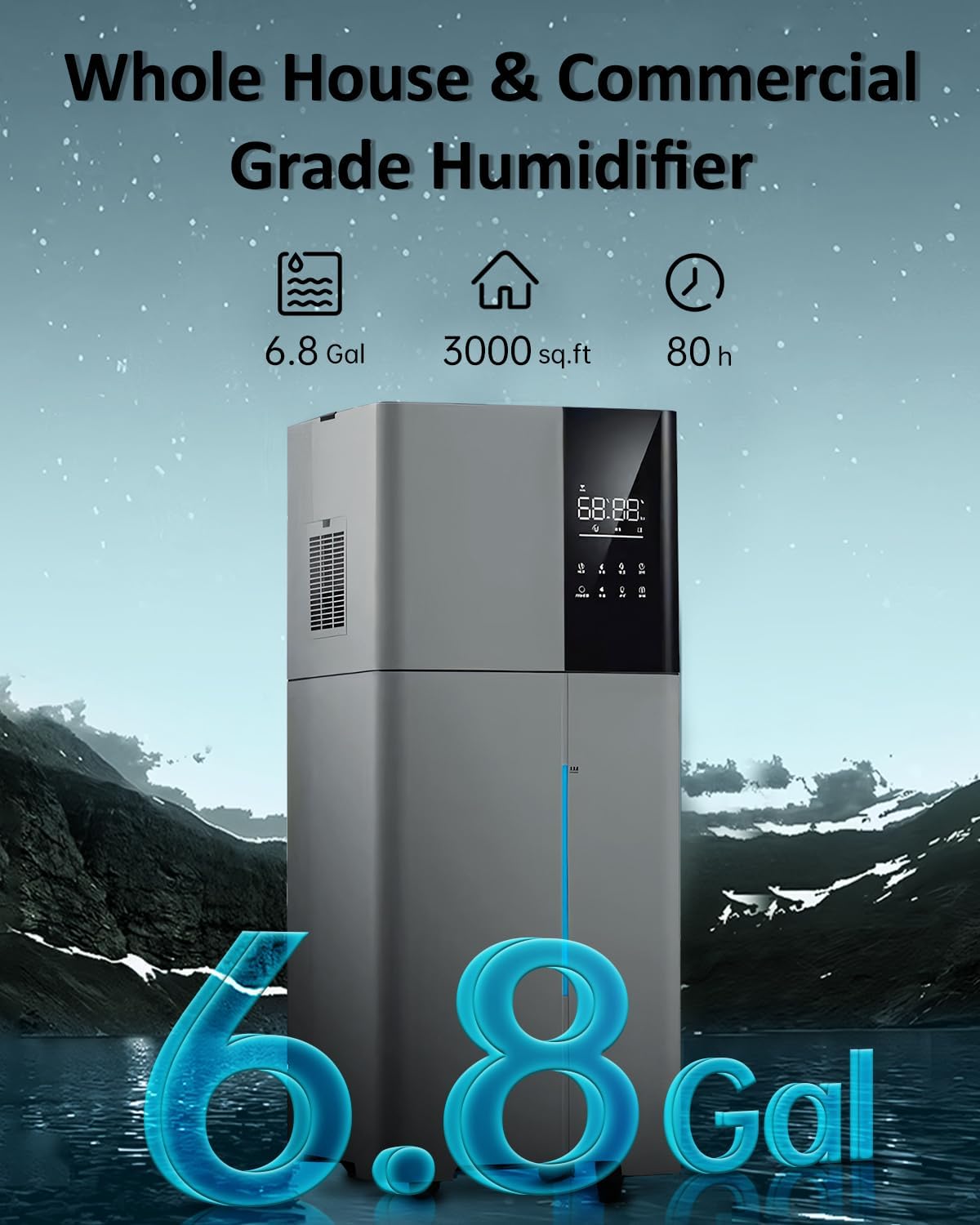
LACIDOLL
$199.99
In stock on Amazon
Check price on AmazonPremium Tier: Fan-Powered and Steam Units for Large or Tightly Sealed Homes
Bypass drum units carry one important limitation that buyers in Climate Zones 5 through 7 frequently discover the hard way: they require the furnace to be actively calling for heat to achieve rated output. If your furnace cycles infrequently during a mild stretch — say, 10°F outdoor temperatures where the house needs only occasional heating — the bypass unit delivers a fraction of its rated GPD.
Fan-powered units such as the Aprilaire 600 or GeneralAire 700 partially address this. They include their own blower, so they can run when the air handler fan is active even without a heat call. They perform meaningfully closer to rated GPD during mild-weather cycling and are the better spec for homes in the 2,500–4,000 square foot range. Equipment pricing runs $250–$380; installed costs typically land at $500–$800 per ACHR News contractor reporting.
Steam units solve the furnace-dependency problem entirely. An electrode or resistance-element steam humidifier — the Aprilaire 800, the Nortec NHMC series, or the GeneralAire Elite GFI — generates steam independently of furnace operation, injects it directly into the supply plenum or return duct, and delivers consistent output regardless of outdoor temperature or heating demand. That is why HVAC contractors in Climate Zones 6 and 7 — Minnesota, Wisconsin, Montana — frequently specify steam for homes above 3,000 square feet. Rated GPD is delivered GPD, not a best-case ceiling.
The tradeoff ASHRAE Standard 55-2023 underscores: steam units require careful maximum-RH control at the building envelope. In a well-sealed home during extreme cold, over-humidification causes condensation inside wall assemblies, leading to mold and structural damage. Building Science Corporation’s BSD-013 is unambiguous on this risk in cold climates. Steam’s power means controls — typically a humidistat paired with an outdoor temperature sensor, or a smart thermostat with dewpoint limiting — become non-optional safety equipment. The Ecobee’s frost control setting, Aprilaire’s Model 76 humidistat, or equivalent dewpoint-based limiting is the correct pairing for any steam installation in a cold climate.
Installed costs for residential steam units run $1,200–$1,800 for an Aprilaire 800-class system. If a dedicated electrical circuit (typically 120V or 240V) is not already available, budget an additional $150–$300 for an electrician. Commercial-adjacent steam (Nortec NHMC, Aprilaire 865) runs $900–$2,500 installed, and water quality requirements at that tier may add a sediment filter or softener to scope.
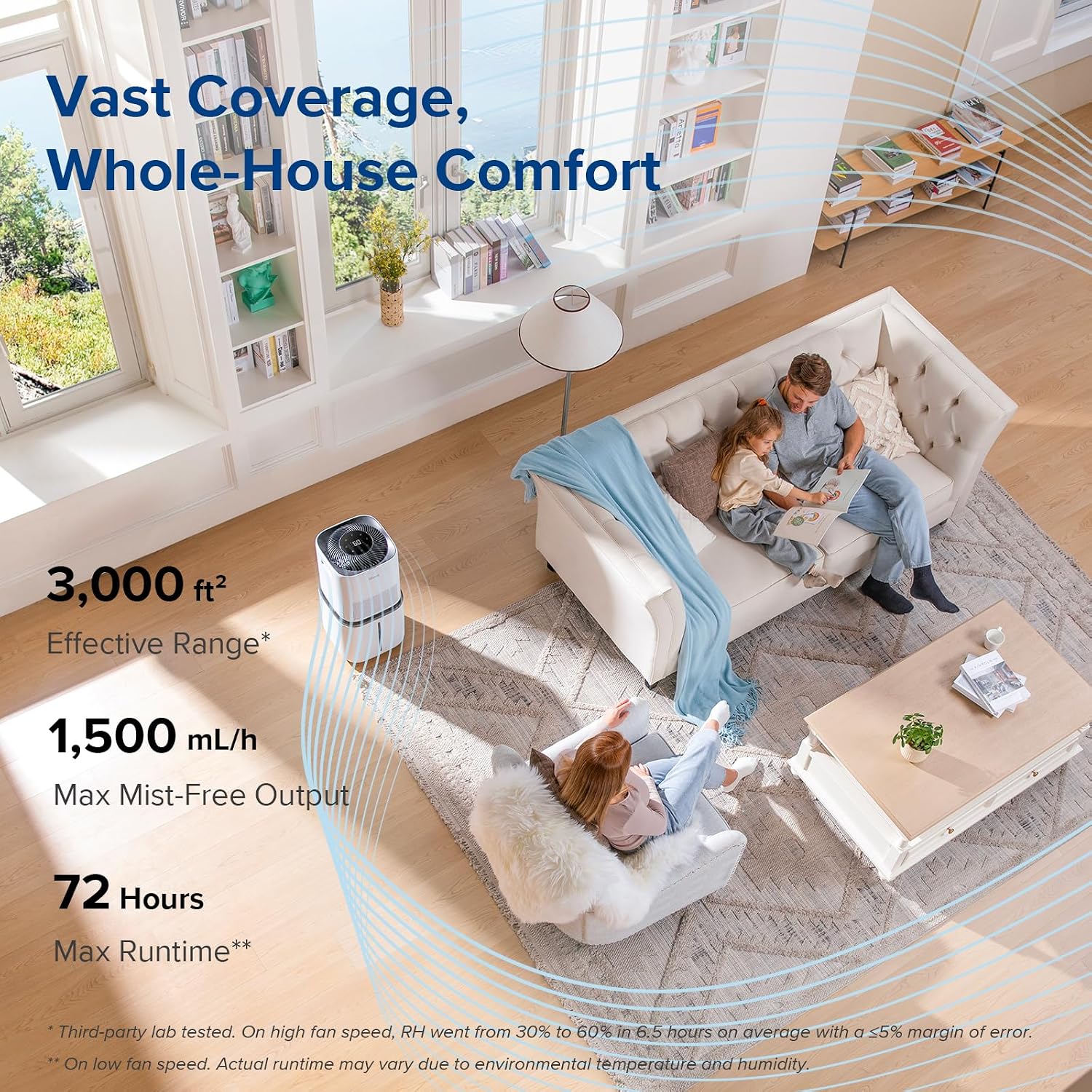
LEVOIT
$224.99
In stock on Amazon
Check price on AmazonWhere Portables Retain a Genuine Advantage
The GPD table does not capture one significant portable advantage: portables do not require your HVAC system to exist or run. This matters in three real scenarios.
Renters. If you cannot install equipment permanently, portables are your only option. A single high-output evaporative console (4 GPD) handles a well-sealed smaller unit reasonably well. Prioritize evaporative over ultrasonic in hard-water markets for the mineral dust reason described above.
Homes without central forced air. Radiant heat, mini-split-only configurations, and older steam-radiator homes have no ductwork to mount a whole-house unit on. Portables — or in-duct humidifiers installed in a dedicated air handler — are the practical path.
Heat-pump-primary homes with bypass units already installed. Heat pumps run lower supply air temperatures than gas furnaces, which reduces evaporation across bypass media significantly. If you’re in a heat-pump home with an existing bypass unit that underperforms, you’re experiencing this effect directly. Fan-powered units perform better in this context. Steam is the cleanest spec for heat-pump homes above 2,000 square feet going forward — a point This Old House’s HVAC coverage has begun surfacing as heat pump adoption accelerates.
The Decision Framework: If X, Then Y
After working through the GPD math, cost analysis, and operational tradeoffs, here is the honest decision rule:
Under 1,200 sq ft, renting, or no central forced air — portables are likely your only practical path. One evaporative console at the 3–4 GPD range handles a well-sealed smaller space adequately. Evaporative over ultrasonic in hard-water markets.
1,200–2,500 sq ft, owned home, furnace runs regularly in winter — a bypass drum unit (Aprilaire 400, Honeywell HE360) is almost certainly the correct move. The installed cost difference over a comparable-output portable fleet typically pays back within two heating seasons in most markets, and maintenance drops to one annual media pad swap.
2,500–4,000 sq ft, or tightly sealed construction, or Climate Zones 5–7 — a fan-powered unit (Aprilaire 600, GeneralAire 700) over a basic bypass. The additional $150–$200 in equipment cost buys meaningfully closer to rated GPD output during mild-weather furnace cycles.
Over 4,000 sq ft, tightly built, new construction, or heat-pump-primary — steam is the only system that reliably delivers whole-home humidity independent of heating demand. Budget for smart controls with outdoor temperature lockout. This is not optional at this tier. As ASHRAE Standard 55-2023 and Building Science Corporation BSD-013 both address, the moisture risk in a well-sealed cold-climate home is real, and steam without dewpoint limiting is how wall assemblies get damaged.
The portable vs. whole-house debate is not really about brand preference or installation willingness. It is a GPD math problem with a cost-of-ownership wrapper. Run the numbers for your square footage, climate zone, and construction type — and the answer is usually less ambiguous than the box-store aisle makes it look.