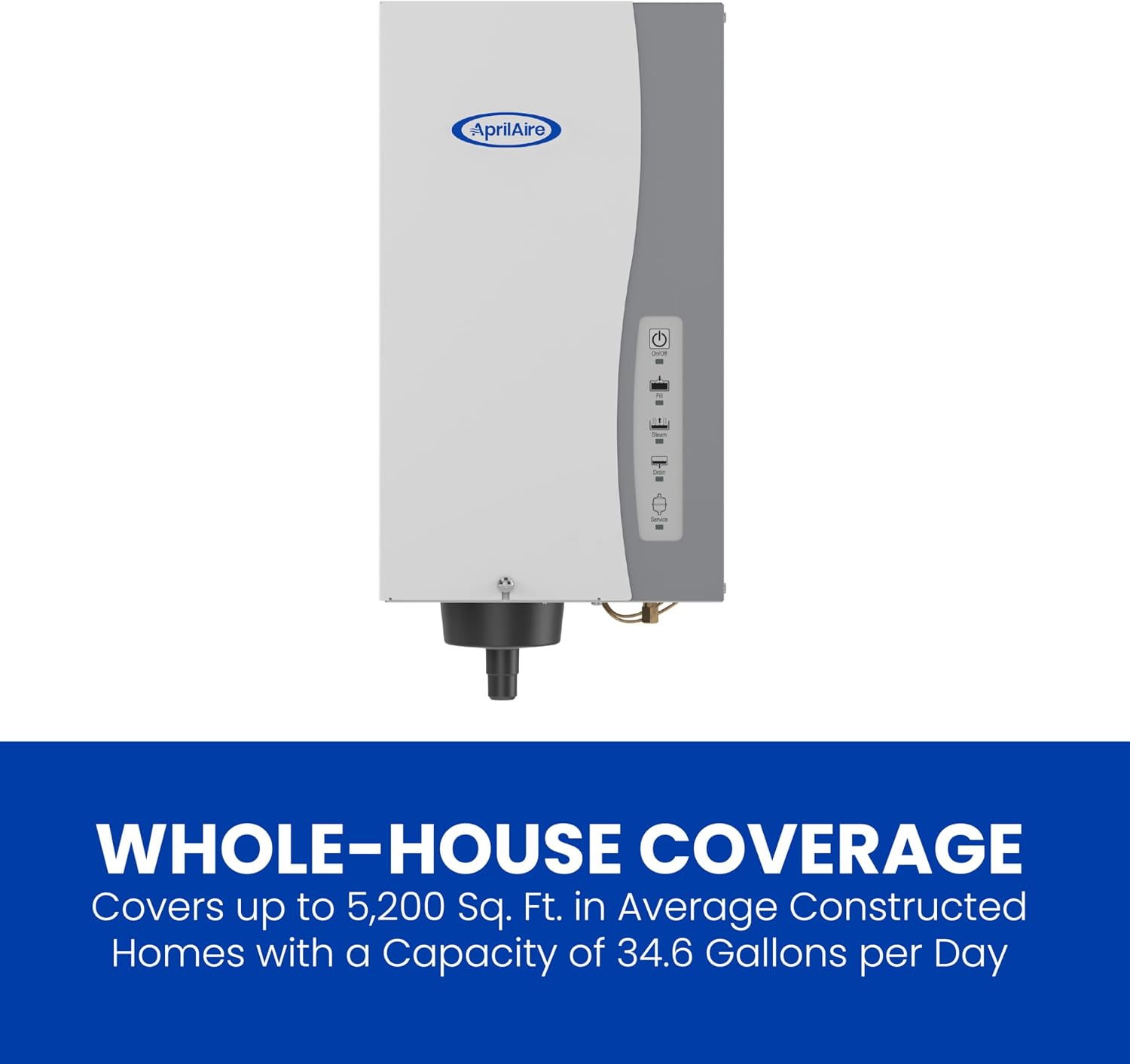
If you’ve ever walked into a house in January and felt the air crackle when you touched a doorknob, you’ve felt what low humidity does. A whole-house humidifier solves that by adding moisture to the heated air that your furnace pushes through your home’s ductwork — the network of metal channels behind your walls. Most entry-level units evaporate water passively. A steam humidifier like the AprilAire 800 does something more powerful: it boils water and injects steam directly into that airstream, which means it works even on heat pumps, delivers precise humidity levels, and doesn’t care how cold it is outside. That performance is why contractors spec it for custom homes and why smart-home clients treat it as a baseline, not an upgrade.
But here’s the thing almost every sales conversation skips: the AprilAire 800’s long-term cost, reliability, and maintenance schedule are not fixed numbers. They are almost entirely determined by the mineral content of your tap water. If your water is hard — loaded with calcium and magnesium — the unit will scale up faster than the manual’s maintenance intervals assume, and your real cost of ownership could be meaningfully higher than the sticker price suggests. This article walks you through how to assess your water, what the numbers mean for the 800 specifically, and when a different approach (or a different unit) makes more sense.
What “Water Quality” Actually Means for a Steam Humidifier
When a steam humidifier boils water, it releases pure water vapor into the air. Everything dissolved in that water — minerals, salts, sediment — stays behind in the boiling canister (called the steam cylinder or canister). Over time, those solids accumulate as scale, a hard chalky deposit that coats the heating element and the canister walls. Scale is to a steam humidifier what clogged arteries are to a circulatory system: it forces the unit to work harder, reduces output efficiency, and eventually causes failure.
The two numbers you need to know are hardness (measured in grains per gallon, or GPG) and total dissolved solids (TDS, measured in parts per million, or PPM). Hardness tracks calcium and magnesium specifically — the primary scale-forming minerals. TDS is the broader figure, capturing everything dissolved in the water, including hardness minerals, sodium, chlorides, and trace metals.
Per the Water Quality Association’s hardness classification:
| Hardness Level | GPG | TDS Rough Equivalent |
|---|---|---|
| Soft | < 1 GPG | < 17 PPM |
| Moderately Hard | 3–7 GPG | 51–120 PPM |
| Hard | 7–10 GPG | 120–170 PPM |
| Very Hard | > 10 GPG | > 170 PPM |
The AprilAire 800 installation and maintenance manual from Research Products Corporation recommends canister replacement when scale buildup visibly impairs function, and suggests that in hard-water areas, that interval can be significantly shorter than the nominal annual cycle. Operators in long-run forum discussions and contractor reviews on ACHR News consistently flag this as the unit’s most under-discussed ownership reality.
The AprilAire 800’s Scale Economics: Show the Math
The AprilAire 800 is manufacturer-rated at up to 34.6 GPD (gallons per day) of moisture output — among the highest capacity residential steam units available, making it suitable for homes up to approximately 6,200 square feet per AprilAire’s own sizing guidance. That capacity is a genuine differentiator. But high throughput also means higher water volume through the canister, which accelerates scale accumulation proportionally.
The cost math that changes by ZIP code:
Replacement canisters for the AprilAire 800 (part number varies by canister type) run approximately $100–$160 at authorized distributors as of spring 2026. In soft-water markets — think Pacific Northwest, upper New England — operators on ACHR News and ContractingBusiness forums report 12–18 month canister life as realistic. In hard-water markets like Phoenix, Las Vegas, or suburban Chicago, the honest range is closer to 4–8 months between replacements under moderate daily use.
Run the numbers on the hard-water scenario:
- Canister cost: $130 (midpoint)
- Replacements per year (hard water, heavy use): 2–3
- Annual canister spend: $260–$390
- Plus labor if contractor-serviced: add $80–$150 per visit
Over five years, that’s a potential $1,700–$2,700 in maintenance costs alone — on top of a unit that lists at roughly $700–$900 at authorized dealers. That’s not a reason to reject the 800; it’s a reason to price the 800 correctly before you recommend it or buy it.
How to Know Your Water Quality Before You Spec the Unit
There are three practical paths, in order of rigor:
1. Your municipal water report. Every public water utility in the United States is required to publish an annual Consumer Confidence Report (CCR). These are typically available on your utility’s website or by request. The report will list hardness in either GPG or PPM and sometimes TDS. This is your fastest free data point. The EPA’s drinking water resources page explains how to access these reports if you can’t find your utility’s directly.
2. An at-home test strip. Hardness test strips (designed for aquariums or home water testing) are widely available and cost a few dollars for a multi-pack. They’re not lab-grade, but they’ll reliably tell you whether you’re in soft, moderate, or hard territory. WaterResearch.net’s overview of TDS measurement notes that consumer strips have ±15–20% accuracy at typical residential concentrations — good enough for a go/no-go on scale risk.
3. A certified water test. If you’re specifying a unit for a client or the municipal report shows borderline numbers (say, 6–8 GPG), a $30–$60 certified lab panel from a state-certified lab gives you hardness, TDS, and iron levels with meaningful precision. Iron above 0.3 PPM is a separate concern — it stains canisters and can accelerate fouling independent of hardness.
The decision threshold the 800’s install manual implicitly sets — though never states this bluntly — is roughly 7–8 GPG as the inflection point where active water treatment becomes worth considering.
Your Three Options When Water Is Hard
Once you know your water is in the hard-to-very-hard range, you have three practical paths. None of them is universally correct; each has a clear tradeoff.
Option 1: Run the 800 as-is and budget for frequent canister replacement
This is the right call when: the job is a retrofit into an existing home with soft-to-moderate water (under 7 GPG), or when the client has a service contract and replacement canisters are already line-itemed into the maintenance agreement.
Tradeoff: Lowest upfront complexity, predictable but ongoing cost. In very hard water markets, this path gets expensive fast.
Option 2: Install a point-of-entry softener or dedicated feed-water softener upstream of the humidifier
A whole-home ion-exchange water softener (which replaces calcium and magnesium with sodium) will dramatically extend canister life. Per the Water Quality Association’s hardness documentation, softened water in the 0–1 GPG range can push canister life to 18–24 months even at high daily output rates.
Tradeoff: A quality whole-home softener adds $800–$1,500 to the project cost plus ongoing salt expense. If the home already has a softener, this is a non-issue. If it doesn’t, you’re essentially asking whether the humidifier maintenance savings over five years justify a new softener — and in most hard-water markets, the math does pencil out, but it changes the sales conversation considerably.
One important note for IAQ-focused clients: softened water does raise the sodium content of the steam slightly, though at normal humidification rates, the ASHRAE 62.1 guidance on acceptable indoor air quality does not flag this as a meaningful health concern for residential settings.
Option 3: Pivot to a different unit architecture
The AprilAire 800 uses a plastic canister with resistive heating elements — a design that’s efficient and reliable in moderate water but accumulates scale on the element surface. Some competitors, including the Nortec NHMC series, use electrode-boiler technology, where electrical current passes through the water itself to generate steam. Scale doesn’t foul an electrode the same way it fouls a coated heating element, and electrode units can often be descaled chemically in place rather than requiring full canister replacement.
Electrode steam humidifiers typically carry a higher upfront cost — the Nortec NHMC commercial-adjacent units are generally specified at $1,200–$2,500 installed — but in very hard water markets (above 10 GPG), the long-run maintenance math can favor them. This is a genuine tradeoff to name explicitly in a client proposal, not a reflexive upsell.
Smart-Thermostat Integration Doesn’t Change the Water Equation
Worth addressing directly because it comes up in nearly every high-spec conversation: integrating the 800 with Ecobee, Nest, or a Savant platform doesn’t alter the water quality dynamic at all. The 800 communicates via a standard humidistat terminal and is compatible with all three platforms using their respective humidifier wiring configurations. Ecobee’s frost-control algorithm, which automatically reduces humidity output at low outdoor temperatures to prevent window condensation, works properly with the 800 in a standard two-wire configuration.
The smart-thermostat integration is genuinely valuable — precise humidity set-point control and automated frost limiting are real benefits over a dumb humidistat. But the canister is still processing the same water regardless of how sophisticated the control logic is. No amount of Ecobee automation prevents calcium from precipitating out of hard water when it boils.
The Decision Rule
If your water is under 7 GPG hardness: the AprilAire 800 is a well-supported, high-capacity steam humidifier with published specs that hold up across installer and operator accounts. Budget one canister replacement per 12–18 months, plan for a 30-minute annual maintenance visit, and spec it with confidence.
If your water is 7–10 GPG: get a precise water test before finalizing the spec. A dedicated feed-water softener or a descaling protocol should be part of the proposal. Put the canister replacement cost in front of the client at signing, not at the first service call.
If your water is above 10 GPG, or if the client has above-average iron levels: compare the 800 head-to-head against an electrode-boiler unit. The 800 can still work in this range with softened feed water, but the default assumption that it’s the best tool for the job stops being safe. Name that tradeoff explicitly — the client who discovers a $400/year canister habit six months post-install is not a reference client.
The AprilAire 800 earns its reputation in the right conditions. Water quality is the condition that decides whether you’re in that range.