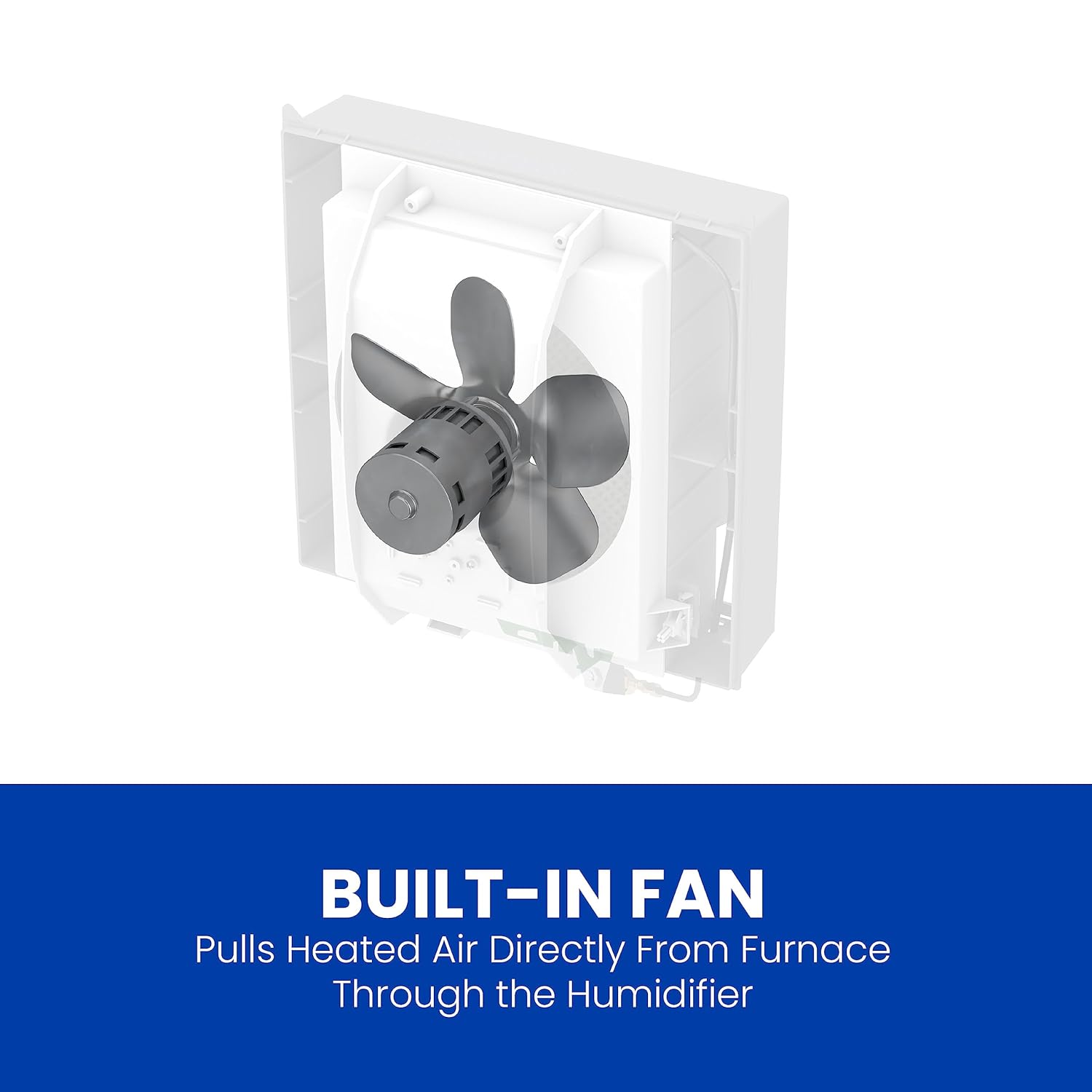
If you’ve been shopping for a whole-house humidifier — a unit that connects directly to your home’s heating and cooling system to add moisture to every room at once — you’ve probably run into two basic categories: bypass humidifiers and fan-powered humidifiers. A bypass unit (like the popular Honeywell HE360 or AprilAire 400) borrows airflow from the furnace blower to push air across a wet pad and into the ducts. It’s simple, affordable, and works fine in the right setup. A fan-powered unit (the AprilAire 700 and 720 being the dominant examples in this segment) has its own built-in fan, so it can run independently of whatever the furnace is doing. That difference — one internal fan — turns out to matter enormously if your home is heated by a heat pump rather than a gas or oil furnace. This article walks you through exactly why, shows the tradeoffs honestly, and gives you a clear decision rule so you’re not guessing on your next spec or proposal.
The Core Problem: Why Bypass Units Fail Heat Pump Homes
To understand the mismatch, you need to know one thing about how bypass humidifiers work: they depend on a temperature differential. Air enters the bypass panel through a dampered duct, passes over a water-soaked evaporator pad (sometimes called a water panel or distribution tray), and that air has to be warm enough to absorb moisture before it reaches the living space. Most bypass manufacturers spec their capacity ratings at a supply-air temperature of 120°F or higher. A gas furnace in heating mode routinely delivers supply air in the 125°F–140°F range. That’s plenty of heat to carry moisture.
A heat pump in heating mode is fundamentally different. Heat pumps work by extracting heat from outdoor air (or the ground) and concentrating it indoors — they don’t generate heat by combustion. As a result, the supply air temperature off a heat pump coil typically runs between 90°F and 105°F, sometimes lower in cold snaps when the system is running supplemental electric strips just to keep up. Building Science Corporation’s research on moisture-control design notes this is one of the most commonly overlooked mismatches in residential IAQ specification: a system sized for one heat source installed in a home with a fundamentally different one.
At 90°F–100°F supply air, a bypass humidifier’s effective output can drop by 30–50% below its rated GPD (gallons per day) capacity, as documented in AprilAire’s own product specification sheets for their bypass line. The pad may stay damp, the solenoid may open on call, but the air passing through simply can’t carry the moisture load. Homeowners notice the humidistat calling constantly, the pad scaling up faster than normal, and relative humidity readings stubbornly stuck in the low 20s during cold weather. ACHR News covered this pattern explicitly in their 2023 heat pump humidification analysis, noting that service callbacks for “humidifier not working” in heat pump homes are disproportionately linked to bypass unit installations rather than any defect in the unit itself.
The fan-powered unit sidesteps this entirely. Because the AprilAire 700 and 720 contain their own motorized fan, they draw air across the water panel under their own power, at a controlled rate, regardless of what the air handler is doing. They don’t need a 120°F supply air temperature to hit rated output. They run on call from the humidistat or control board, whether the heat pump is in heating mode, cooling mode, or idle. That independence is the whole game.
AprilAire 700 vs. 720: The Spec Comparison That Actually Matters
The 700 and 720 are siblings — same platform, same fan-powered architecture, meaningfully different capacity. Before you spec one over the other, here’s the math.
By the numbers:
| Model | Rated Output | Water Panel | Coverage (Tightly Built) | Coverage (Leaky/Older) |
|---|---|---|---|---|
| AprilAire 700 | 18 GPD | #35 | Up to 4,200 sq ft | Up to 2,800 sq ft |
| AprilAire 720 | 17 GPD | #35 | Up to 4,000 sq ft | Up to 2,500 sq ft |
(Source: AprilAire Product Specification Sheets, 2024. “Tightly built” per ASHRAE 62.2 infiltration classifications.)
The raw GPD difference between the two is modest — one gallon per day. The more meaningful distinction is the control input: the 720 ships with an automatic digital humidistat (the Model 62 control) that reads both indoor humidity and outdoor temperature and automatically adjusts the target setpoint to prevent window condensation. The 700 in its base configuration pairs with a manual humidistat. You can upgrade the 700 to automatic control by adding an AprilAire 76 or 62 controller — this is a common upsell on installs, and frankly the right call in most climates — but the 720 bundles it out of the box.
For a practitioner framing: if you’re specifying for a client who will adjust a manual control seasonally, the 700 plus a separately sourced controller may give you more flexibility (the 76 controller, for instance, integrates more cleanly with some third-party thermostats). If the client wants a set-it-and-forget-it system, or if smart-thermostat integration isn’t in scope, the 720’s bundled auto-control is the simpler path.
One thing published specs don’t resolve is real-world performance in very dry climates or older homes with high air leakage — both the 700 and 720’s coverage numbers assume reasonably modern construction. Building Science Corporation’s moisture-control literature consistently emphasizes that infiltration rate is the dominant variable in humidifier sizing, not square footage alone. A 2,500 sq ft ranch with 1970s balloon-frame construction and no air sealing may need more than an 18 GPD unit can deliver in a sustained cold snap. Name that tradeoff in your proposal before the client names it to you in January.
Installation Realities: What Changes When You Drop the Bypass Damper
Replacing a bypass humidifier with a fan-powered unit on an existing installation is usually straightforward, but there are three specifics worth flagging before you pull the permit.
No bypass duct needed. A bypass humidifier requires a dedicated duct loop from the return plenum to the supply plenum so blower pressure can push air through the water panel. Fan-powered units eliminate that loop — the 700/720 mount directly to the supply or return plenum (supply-side is preferred for output efficiency) and the integral fan does the work. On a retrofit, that means capping or removing the existing bypass duct, which is typically a 6-inch round run. This is a labor credit on most installs, partly offsetting the unit cost premium.
Electrical requirement. The 700 and 720 require a 120V/60Hz power connection, typically 2.5 amps. Bypass units need only a 24V signal from the control board. On a new installation this is a line-item add — a dedicated outlet or hardwired circuit in the mechanical room. On a retrofit, you’re either tapping an existing receptacle near the air handler or adding a circuit. Budget accordingly; This Old House’s whole-house humidifier overview confirms this is the most commonly overlooked added cost on fan-powered retrofits.
Drain line. Both models are flow-through designs — they waste a portion of supply water to prevent mineral buildup on the pad. AprilAire rates drain water flow at approximately 0.75 to 1.5 times the humidified output depending on water hardness. The drain line (typically 1/2” tubing) must run to a floor drain, utility sink, or condensate pump. In many mechanical rooms this already exists for the furnace condensate; in others it’s a new run. High-iron or high-hardness water accelerates pad scaling regardless of model — owners and service technicians in hard-water markets (much of the Midwest and Mountain West) consistently report that pad replacement intervals compress from the standard annual recommendation to every 4–6 months on untreated water above 10–12 grains per gallon.
Smart Thermostat Compatibility: Where to Watch Your Step
This is where practitioner-level specification earns its keep. The AprilAire 700 and 720 use a simple 24V humidifier terminal connection — in principle, compatible with any thermostat that has a humidifier output (labeled HUM, ACC+, or similar). In practice, there are quirks.
Ecobee thermostats implement what they call “frost control” — the thermostat’s own outdoor temperature sensor (or integrated weather data on newer models) can suppress the humidifier call at low outdoor temperatures to prevent condensation on windows and cold exterior walls. ASHRAE Standard 160-2021 supports this approach from an envelope durability standpoint. But the control algorithm isn’t user-transparent, and some installers report the humidifier being suppressed more aggressively than the homeowner expects in climates below 20°F. The workaround is to spec the AprilAire 62 or 76 auto-controller as the primary humidity control, wired directly to the humidifier, with the Ecobee in the loop only as the call-to-run signal — effectively letting the AprilAire controller manage setpoint adjustment and using the thermostat as a relay. More wiring, more clarity.
Nest thermostats use a * (star) or HUM terminal depending on generation. The Nest Learning Thermostat (3rd gen and later) will control a humidifier, but Nest’s humidity control in heating mode is tied to whether the system is actively heating — it won’t run the humidifier independently. For a fan-powered unit that is supposed to operate independently of the air handler, this can suppress runtime and underperform. Again, the AprilAire standalone controller solves this; it’s not a workaround so much as the intended architecture for installations where precise humidity control is the priority.
Honeywell/Resideo T10 Pro with its dewpoint-based humidity control mode is, by most published accounts and contractor field experience reported in ACHR News, the cleanest integration path for AprilAire fan-powered units if the client is also upgrading the thermostat. The T10’s outdoor sensor loop and dewpoint limiting logic parallels what the AprilAire 62 controller does natively, reducing the risk of double-correcting.
The Decision Rule
If your home or your client’s home runs on a heat pump as the primary heat source, a bypass humidifier is the wrong tool — not because bypass units are poorly made, but because they were designed around a heat source that runs hotter than a heat pump does. The AprilAire 700 and 720 are the established answer in this price tier, with published specs, wide installer familiarity, and a supply chain that’s stabilized after the 2022–2024 component disruptions.
If X, then Y:
- Heat pump primary, up to 4,000 sq ft, smart thermostat integration desired: AprilAire 720. Bundle the auto-control, use the AprilAire 62 controller as the humidity brain, and connect the thermostat as the call-to-run relay. Cleanest setup, lowest callback risk.
- Heat pump primary, larger home or high-leakage construction, contractor wants control flexibility: AprilAire 700 plus the AprilAire 76 controller. Same output, more third-party thermostat wiring options, meaningful at scale if you’re specifying across multiple builds.
- Gas or oil furnace, budget-driven project, supply air confirmed above 120°F: A bypass unit (AprilAire 400, Honeywell HE360) is still a defensible spec — just confirm supply air temperature before writing it in.
- Hard water above 10 grains per gallon in any of the above: Quote the pad replacement cadence honestly up front and consider a point-of-use treatment upstream of the humidifier. The unit will work; the maintenance math will surface if you don’t name it first.
The premium over a bypass unit — typically $100–$200 in hardware plus the electrical circuit cost — pays back in performance and in not having to explain a callback in February. That’s the tradeoff, named plainly. The rest is your call.